
Montessori Toys vs Regular Toys: Key Differences, Cost and Long-Term Value

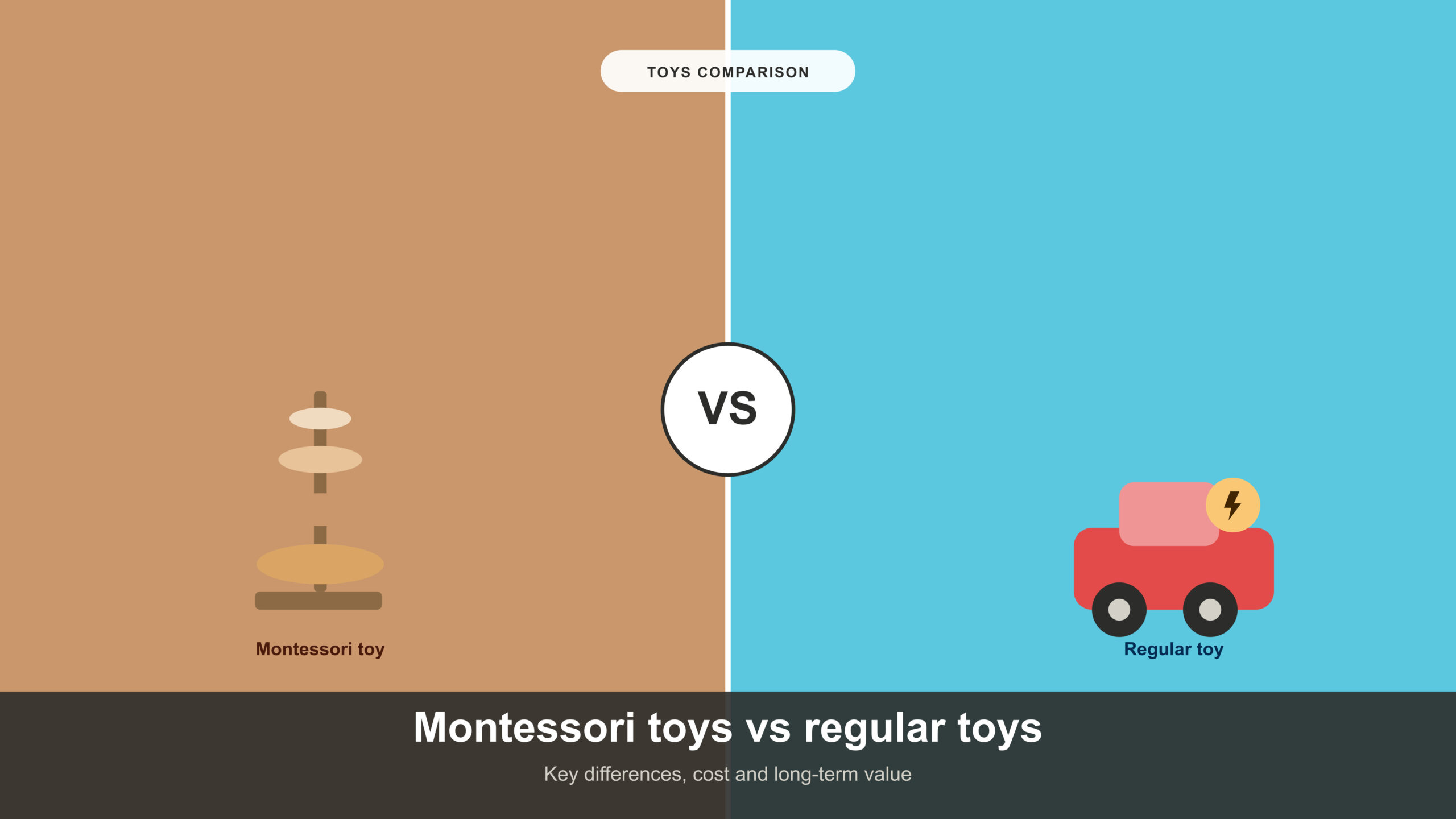
The difference between Montessori toys and regular toys mainly comes down to who does the work — the child or the toy. Montessori-aligned toys require children to actively sort, match, stack, pour, transfer, build, or solve a problem. Regular toys cover a much broader category and may include pretend-play sets, characters, electronic features, or fixed entertainment functions. The distinction lies mainly in design purpose and child participation, not simply whether a toy is wooden or plastic.
A useful question to ask is: does the child create the activity, or does the toy perform most of it? Age suitability, purpose, safety, level of challenge, and opportunities for interaction matter just as much.
Montessori Toys vs Regular Toys: A Side-by-Side Comparison
| Comparison point | Montessori-aligned toys | Regular toys |
| Primary purpose | Practising a defined skill or concept | Entertainment, imaginative play, or mixed learning |
| Child’s role | Child performs the main action | Toy may provide sounds, movement, or instructions |
| Design | Usually simple and focused | May include several features, colours, or characters |
| Learning approach | Repetition, exploration, and self-correction | May involve guided, electronic, or narrative play |
| Materials | Often wood, metal, fabric, or mixed materials | Commonly plastic, fabric, electronics, or mixed materials |
| Power source | Usually child-powered | May be child-powered or battery-operated |
| Feedback | Often built into the activity | May come from adults, sounds, lights, or screens |
| Durability | Depends on construction and maintenance | Depends on material, design, and build quality |
Material alone doesn’t decide whether a toy is Montessori-aligned. A wooden toy isn’t automatically better than a plastic one, and neither category is universally good or bad. Material does still affect durability, weight, sensory experience, cleaning, and safety, so it’s worth weighing alongside the toy’s actual design.
How Montessori Toys Change the Child’s Role in Play
In many Montessori-inspired toys, the object stays passive while the child stays active.
A few features drive this shift:
- The material doesn’t complete the activity for the child, the child has to do the work.
- One challenge at a time. Many Montessori materials isolate a single concept or skill, so children can focus without distraction.
- Control of error. Many materials are designed so a mistake is visible to the child, letting them notice and correct it independently
- Repetition. Children repeat an action as many times as they need to, building coordination and independence at their own pace, one step at a time.
Simple, screen-free toys also support communication and hands-on exploration. The American Academy of Pediatrics recommends traditional, hands-on toys and cautions that electronic or digital toys shouldn’t replace real, face-to-face interaction and play. When choosing screen-free toys, age suitability and safety still matter most.
Why Are Montessori Toys Expensive?
Why are Montessori toys expensive? It is a common question that parents ask. Pricing can reflect several factors:
- Precisely cut and proportioned components
- Durable wood, metal, cotton, or other quality materials
- Smooth edges and detailed finishing
- Child-safe paints, coatings, and adhesives
- Product testing and quality-control processes
- Smaller production quantities
- Replaceable pieces or repairable construction
Does the Higher Price Offer Better Long-Term Value?
Are Montessori toys worth it? A simple way to think about it is cost per use:
Cost per use = Purchase price ÷ Estimated number of uses
A well-constructed toy can be used repeatedly — passed between siblings, reused across school terms, or rotated between classrooms in the same institution. A simpler, cheaper toy can offer good value too, provided it stays safe and engaging.
Long-term value depends on:
- Frequency of use
- Construction quality
- Ease of cleaning and storage
- Age range it suits
- Availability of repair or replacement parts
- Resale or reuse potential
It’s best not to claim a fixed lifespan for any product without data to support it. The strongest Montessori toy benefits come from repeated use and the child’s growing ability to work independently.
Are Regular Toys Bad for Children?
Not at all. Dolls, vehicles, building blocks, art supplies, and pretend-play sets all support language, imagination, fine motor skills, and social play. The concern isn’t whether a toy is labelled “regular”, it’s whether the toy:
- Keeps the child actively involved
- Matches the child’s age
- Allows meaningful play
- Is safe
- Avoids excessive reliance on lights, sounds, or screens
The wooden toys vs plastic toys comparison should look at design and purpose too, not material alone.
How to Choose Between Montessori and Regular Toys
To understand how to identify Montessori toys, one has to ask the following questions:
- What skill or type of play does the toy support?
- Does the child perform the activity?
- Is the challenge appropriate for the child’s stage?
- Can the toy be used repeatedly?
- Does it encourage concentration or interaction?
- Can the child understand how to use it on their own?
- Is it safe, stable, and easy to clean?
- Will it stay useful once the initial novelty fades?
- Are its materials and any certifications clearly documented?
Families don’t need to choose only one category. A well-rounded play environment can include Montessori-inspired toys alongside books, blocks, art materials, and imaginative play.
Invest in Purposeful, Long-Lasting Learning Materials
Kidken Edu Solutions offers Montessori materials for Infant and Toddler programs (0–3 years), Early Childhood environments (3–6 years), and Elementary learners (6–12 years), spanning Practical Life, Sensorial, Language, and Mathematics categories. Schools and parents can treat these as long-life development materials — built for purposeful activity and independent exploration.
Kidken’s Montessori preschool setup resources can support schools planning an organised learning environment, and proper preschool furniture helps make the classroom more accessible, comfortable, and easier to maintain.
Frequently Asked Questions
Are all wooden toys Montessori toys?
No. Material alone does not make a toy Montessori-aligned. Look at its purpose, the
child’s role, developmental suitability, simplicity, safety, and opportunities for repetition or
independent use.
Are Montessori toys worth the price?
It is up to you to decide whether a toy is worthy of your money. Remember that its
price does not necessarily reflect the educational value. Check the toy’s purpose, construction, and
fit for your child before deciding.
Do Montessori toys always avoid batteries?
Authentic Montessori classroom materials are generally operated by the child rather
than by batteries. However, being battery-free doesn’t automatically make a product
Montessori-aligned.
What are Montessori Generation toys?
Montessori Generation toys are a commercial range of products. Since this type is
not acknowledged by the Montessori philosophy, you will have to examine each toy and assess each
product’s purpose, safety, construction, and the child’s role.