
Blog
How to Train Teachers for Montessori Classrooms Even Without Experience

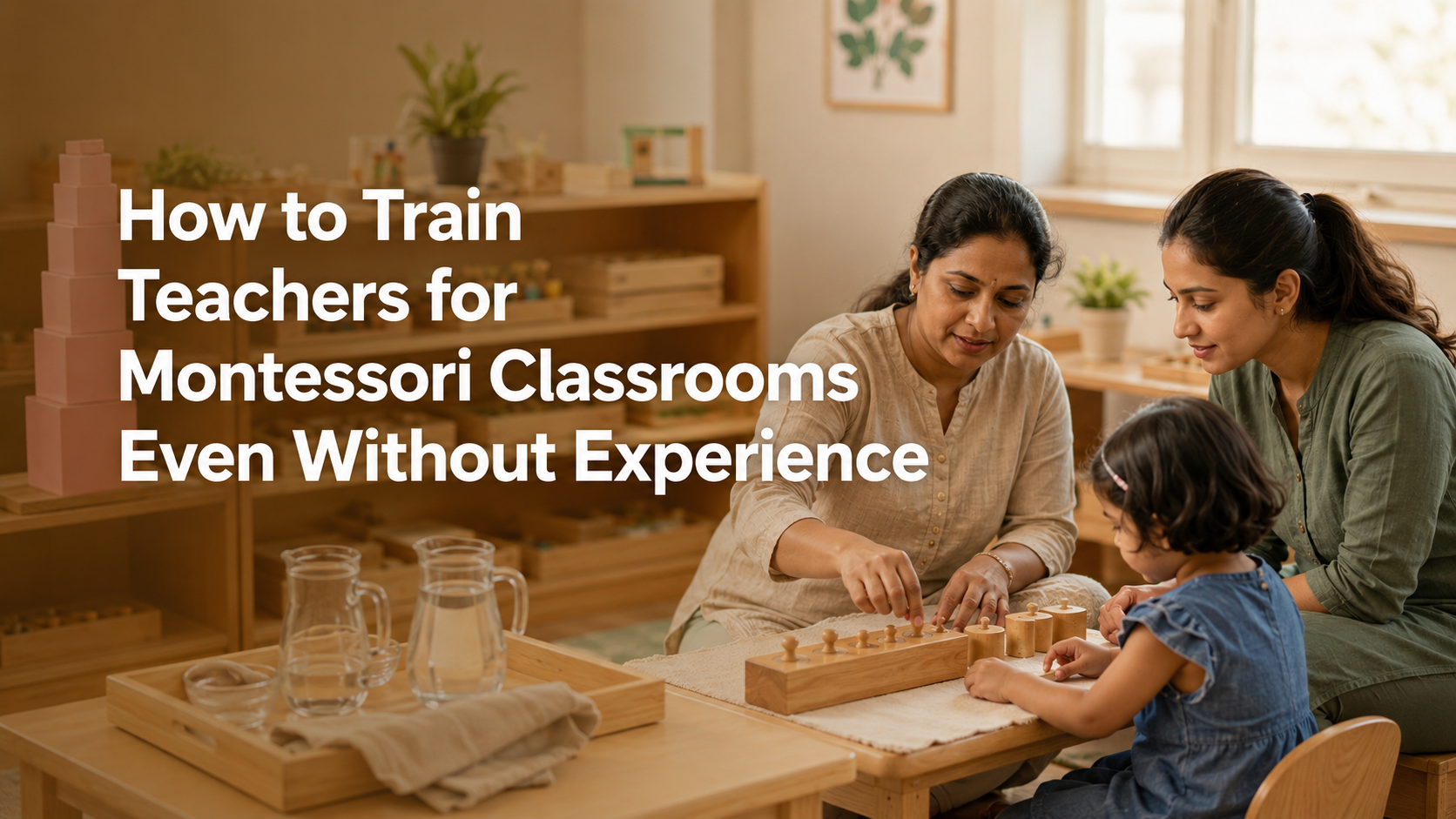
Hiring for a new preschool or expanding an existing early childhood center often brings school owners face-to-face with a persistent challenge: finding educators who have strong experience in the Montessori method. Finding teachers with strong Montessori classroom experience can be difficult, especially for new preschools or expanding school chains. This shortage frequently leaves administrators with a difficult choice—either delay school admissions or hire enthusiastic, fresh candidates who possess little to no prior experience with this Montessori method.
Transitioning a traditional educator or a complete beginner into an authentic Montessori role requires far more than handing them a curriculum book. Traditional teaching relies on a top-down model where an adult lectures a uniform group of children. In contrast, the Montessori approach requires a different teaching mindset. The educator stops acting as the focal point of the classroom and instead becomes a quiet observer, an environmental designer, and a dynamic link between the child and scientifically structured learning tools.
A successful internal development program focuses heavily on child psychology, the science of observation, and the precise physical presentation of materials. When built upon a structured, practical framework, fresh candidates can transform into deeply confident Montessori guides. Navigating this logistical and academic transition becomes significantly more manageable with an experienced execution partner. This is where a practical setup partner like Kidken Edu Solutions can support schools with classroom planning, Montessori materials, curriculum guidance, and teacher orientation.
Can Teachers Be Trained for Montessori Without Experience?
Yes, fresh candidates can be successfully trained to manage authentic classrooms through a structured program combining Montessori philosophy, child psychology, and classroom observation. The process requires systematic instruction in material handling, supervised practical rehearsals, and ongoing professional mentoring. With the right training plan, even fresh teachers can learn how to observe children, present materials, manage the classroom calmly, and communicate progress to parents.
Why Montessori Teacher Training Matters More Than Prior Experience
Montessori teaching is different from regular preschool teaching
In a standard early learning center, the educator operates as an instructor who dictates the pace of the day, controls group transitions, and delivers collective lessons. An authentic Montessori classroom functions on an entirely different operational axis. Here, the adult acts as a guide or directress. Their primary responsibility is to maintain the order of the prepared environment and step back to allow children to learn through deeply focused, self-directed work. They do not force knowledge onto the child; they connect the child to the correct material at the precise moment of developmental readiness.
Fresh teachers can succeed with structured training
A complete lack of prior classroom experience can actually serve as a distinct advantage when training a new team. Experienced traditional teachers often struggle to break entrenched habits like over-instructing, constantly interrupting a focused child, or relying on external rewards and punishments. A beginner approaches the training process with a clean slate. If your internal onboarding system provides clear, practical instruction paired with supervised floor time, a novice can master presentation dynamics and observation methods faster than a traditional teacher attempting to unlearn decades of conventional lecturing.
What happens when teachers are not trained properly
Investing capital into a beautiful classroom layout without thoroughly preparing your staff always results in operational failure. Without a deep understanding of pedagogical intent, expensive tools sit unused on shelves or degrade into random playthings. The classroom environment quickly becomes noisy and chaotic, causing teachers to resort to over-instruction, forced circle times, and a dependency on uninspired paper worksheets to keep children quiet. This breakdown destroys the natural flow of the room, drives up staff burnout, and triggers negative parent reviews that damage your enrollment metrics.
Why training should begin before admissions open
The internal atmosphere of your classroom during the first month of school dictates your institution’s long-term local reputation. If parents walk past a window and see an orderly, calm environment where three-year-olds are independently cleaning tables and handling mathematical tools, your school builds instant brand authority. Achieving this level of cultural harmony requires your teaching team to be completely ready long before children cross the threshold. Training must begin well in advance of opening day so guides can master their physical movements, practice team collaboration, and project absolute confidence during initial parent orientations.
What Makes a Good Montessori Teacher?
A guide, not a traditional instructor
An exceptional guide possesses the unique ability to become functionally invisible once deep concentration emerges within the room. They do not seek to be the center of attention. Their talent lies in delivering quiet, individualized lessons and then withdrawing gracefully so the child can interact directly with the learning apparatus.
Strong observation skills
Observation is the primary diagnostic tool of an authentic guide. A trained teacher does not guess what a child needs; they sit quietly and take precise notes. They watch how a child holds a tray, track how many times an activity is repeated, note where frustration occurs, and identify when a student is ready to transition to a more complex concept.
Understanding child psychology
An effective Montessori educator understands the inner workings of the early childhood mind between the ages of birth and six years. They recognize what Dr. Montessori termed “sensitive periods”—temporary windows of intense developmental focus where a child is naturally driven to master specific skills like order, language, or sensory refinement.
Ability to present materials correctly
Montessori materials have a specific purpose, sequence, and method of presentation. A teacher must know how to introduce each material with slow movements, minimal words, and clear focus. This is why material presentation practice should be part of every Montessori teacher training program. They must practice moving their hands slowly, minimizing spoken words during the presentation, and isolating the specific lesson so the child’s eyes focus entirely on the physical movement rather than auditory distraction.
Patience, silence, and classroom discipline
Discipline in this environment is never achieved through loud reprimands, gold stars, or timeout chairs. True discipline is an internal state that emerges naturally when a child finds purposeful work that matches their developmental needs. A great guide models this internal calm through a low speaking tone, slow physical movements, and an unwavering respect for every child’s personal space.
Parent communication skills
A well-trained teacher must confidently articulate child progress without relying on traditional metrics like test scores, grades, or stacks of completed worksheets. They must be capable of translating a child’s interaction with physical materials into clear developmental milestones, explaining to parents how washing a table builds the hand-eye coordination and left-to-right tracking required for early reading.
Step-by-Step Montessori Teacher Training Process
Step 1: Begin with Montessori philosophy
Before a new hire touches a single classroom object, they must deeply understand the core philosophical framework. Onboarding must cover the concept of the absorbent mind, the preservation of child independence, the strict boundaries of freedom within limits, and the absolute necessity of respecting the child’s individual timeline.
Step 2: Teach child development for ages 0–6
Trainers must ground new teachers in the physical, neurological, and emotional realities of early childhood. Staff need to know how motor skills stabilize, how language capacity expands, and why physical movement is completely tied to cognitive development during these formative years.
Step 3: Arrange classroom observation
New teachers should spend dedicated hours sitting silently in an active, functioning classroom before attempting to lead one. This non-participatory observation teaches them to read the room, understand the natural flow of child traffic, see how an experienced guide uses tone to redirect energy, and watch how children interact with materials.
Step 4: Introduce Montessori material categories
Organize your curriculum training into distinct, manageable blocks. Walk your team systematically through the foundational curriculum areas:Practical Life, Sensorial, Language, Mathematics, Culture, and Grace and Courtesy.
This ensures teachers understand how skills built in the first area directly support success in the next.
Step 5: Practice material presentations
An educator should never present an apparatus to a child for the first time without exhaustive prior practice. Rehearsal sessions should be conducted with peers, where one teacher acts as the guide and another acts as the child. This practice irons out clumsy hand movements and builds confident delivery.
Step 6: Start supervised classroom practice
Transition your trainees onto the live classroom floor under the direct supervision of an academic coordinator or senior mentor. This live feedback window allows a senior educator to observe the trainee’s presentation style, environmental positioning, and real-time management of child interactions.
Step 7: Build lesson planning and record-keeping habits
Montessori lesson planning is deeply individualized rather than group-oriented. Train your team to maintain rigorous tracking logs for every student. Teachers must learn to document which materials have been presented, which ones are currently being practiced, and which concepts have been fully mastered.
Step 8: Continue mentoring after classroom launch
Initial onboarding simply sets the foundation; true teaching expertise takes months to mature. Establish a continuous professional development schedule that includes monthly classroom reviews, peer observation sessions, and targeted refresher workshops to address specific operational challenges as they arise throughout the academic year.
Core Areas Every Montessori Teacher Should Be Trained In
Practical Life activities
This foundational area focuses entirely on daily living skills that develop fine motor control, hand strength, concentration, and spatial awareness. Teachers must learn how to present exercises in pouring liquids, spooning grains, buttoning frames, polishing wood, and folding cloths. These simple physical tasks directly prepare the hand muscles for writing.
Sensorial learning
Sensorial materials are engineered to help children organize, categorize, and clarify the physical impressions they have absorbed from the world. Guides must be trained to introduce tools that isolate dimensions, weights, colors, textures, sounds, and geometric shapes, ensuring they understand the underlying scientific purpose of every physical piece.
Language development
Training in this area spans the entire path from spoken phonetics to early creative writing and reading comprehension. Educators must master the presentation of vocabulary baskets, the tactile tracing of sandpaper letters, the phonetic analysis of the movable alphabet, and the structured introduction of early reading folders.
Early mathematics
The Montessori math curriculum moves beautifully from the absolute concrete to the highly abstract. Teachers must understand how to utilize physical number rods, tactile spindle boxes, and mathematical bead stairs to teach clear quantity before introducing abstract numeric symbols, eventually transitioning students into the decimal system using concrete physical models.
Culture, nature, and science
This expansive subject area introduces young minds to geography, zoology, botany, history, and physical sciences. Guides must be trained to present impressionistic geography puzzle maps, plant classification cards, animal life-cycle models, and simple, hands-on scientific experiments that spark curiosity about the natural world.
Grace and courtesy
Classroom harmony depends on the deliberate modeling of social interactions. Teachers must explicitly train children how to greet a guest, wait patiently for a peer to finish using a material, walk carefully around floor mats, offer assistance politely, and resolve minor interpersonal conflicts using quiet words.
Classroom movement and order
A peaceful room requires clear operational boundaries. Guides must learn how to teach children to select a floor mat, unroll and roll it precisely, carry heavy trays with two hands, walk safely around the room without bumping shelves, and return every material to its exact home in pristine condition.
Montessori Teacher Training Checklist
| Training Area | What to Train | Why It Matters |
| Montessori Philosophy | Respecting choices, freedom within limits, child autonomy. | Instills the foundational mindset required to guide rather than control. |
| Child Psychology | Sensitive periods, psychological milestones, motor development. | Empowers teachers to accurately match activities to a child’s natural developmental path. |
| Observation | Detailed note-taking, identifying focus, spotting frustration. | Shifts teaching from generic group timetables to personalized individual learning. |
| Material Presentation | Precise physical manipulation, left-to-right tracking, minimal talking. | Guarantees that children learn the correct usage and intent of every tool. |
| Classroom Management | Establishing daily routines, modeling grace, managing room traffic. | Creates an orderly, peaceful environment that encourages deep focus. |
| Lesson Planning | Tracking individual readiness, pacing advanced lessons. | Maintains consistent academic progress tailored to individual student speeds. |
| Record Keeping | Master tracking logs, progress notations, presentation records. | Provides clear, empirical data to guide daily classroom interactions. |
| Parent Communication | Translating physical work into milestones, managing expectations. | Cultivates deep institutional trust and parental alignment with school values. |
Classroom Observation: The First Training Ground
What new teachers should observe
When a trainee sits in an active classroom, their focus must remain on the subtle mechanics of the environment. They should watch the overarching classroom flow, take careful note of the head teacher’s vocal modulation, observe how children navigate choices, track the length of student concentration spans, and study exactly how behavioral boundary testing is quietly resolved.
Why observation should happen before teaching
Attempting to manage a self-directed classroom without observing one first is highly disorienting for a new teacher. Direct observation allows a trainee to see that a calm room is not maintained through constant adult interference, but through the structured relationship between the children and the physical space.
How coordinators can structure observation hours
Academic coordinators should implement a phased observation strategy to maximize retention: For example, the first stage can focus on classroom flow, the second on material presentations, the third on child behaviour, and the fourth on assisted teaching.
This graduated exposure allows the trainee to assimilate classroom operational layers without feeling overwhelmed.
What teachers should record during observation
Trainees should maintain an observation journal, focusing on objective behaviors rather than subjective opinions. They should record which materials attract the highest repetition, how children handle transitions between activities, where traffic bottlenecks occur, and how independent cleanup is managed.
How observation improves classroom confidence
Watching successful self-regulation in children completely alters a teacher’s inner perspective. Once a trainee witnesses a four-year-old independently resolve a water spill without panic or adult prompting, they lose the nervous urge to over-manage, instantly making them calmer and far more precise when they finally step into a live leadership role.
Hands-On Training with Montessori Materials
Why teachers must practice before presenting to children
If a guide fumbles with a material, drops a piece, or confuses the steps during a live demonstration, the child’s focus is immediately shattered. The presentation must look effortlessly fluid and natural. Exhaustive personal practice ensures that the teacher’s physical movements are clear, confident, and perfectly calibrated to be copied by the child.
How each material supports one learning objective
Montessori tools are never multi-purpose toys designed for random entertainment. Every item isolates a specific concept. The cylinders with knobs isolate size discrimination; the color tablets isolate chromatic tone. Teachers must know exactly what each material isolates so they do not inadvertently confuse the child by introducing outside concepts during the lesson.
Why sequence matters in Montessori education
The entire curriculum functions as an integrated, long-term ladder. A child cannot master the abstract mathematics of the decimal system without first mastering the concrete dimensions of the pink tower and the quantitative lengths of the number rods. Teachers must be thoroughly trained in this structural sequence so they never introduce an advanced material out of order.
How to train teachers using Preschool Learning materials
Practical training should always utilize the exact, durable preschool learning materials that your staff will handle every single day on the school floor. Training with actual classroom stock ensures that teachers develop a precise physical familiarity with the weight, scale, and storage requirements of their specific school inventory.
How Kidken Edu Solutions supports material-based training
A high-quality teacher training strategy requires access to a physically accurate, reliable material pipeline. Kidken Edu Solutions supports school owners with Montessori materials, preschool learning materials, furniture, curriculum guidance, and classroom setup support. This helps teachers practise with the same material size, weight, sequence, and storage system they will use with children. By ensuring that your classroom inventory matches precise pedagogical specifications, Kidken helps your academic coordinators conduct accurate training sessions where material presentation steps align perfectly with global standards.
How School Owners Can Build a Montessori Teacher Training Plan
Phase 1: Pre-opening foundation training
Dedicate the initial weeks of your training plan entirely to core theory, the daily schedule, children’s safety protocols, and the psychological preparation of the adult guide. This establishes a shared vocabulary and a unified cultural standard across your entire teaching team.
Phase 2: Classroom setup and shelf arrangement
Have your teaching staff actively participate in unpacking, cleaning, and arranging the classroom shelves. Physically placing the materials in their correct left-to-right, simple-to-complex sequence ensures that teachers deeply understand the spatial logic and visual order of the prepared environment.
Phase 3: Demo presentations and mock sessions
Run daily mock presentation blocks where teachers deliver formal lessons to one another under the guidance of an academic coordinator. These peer-to-peer reviews allow staff to identify awkward hand positioning, eliminate unnecessary speech, and refine their body language before children arrive.
Phase 4: Live classroom mentoring
During the initial weeks of operation, assign senior mentors or coordinators to stand back and quietly shadow new teachers on the live floor. Provide targeted feedback sessions at the end of each school day to address real-world challenges in behavior management, pacing, and individual lesson delivery.
Phase 5: Monthly review and refresher training
Never treat professional onboarding as a single, closed event. Schedule regular monthly review sessions to audit classroom tracking records, re-examine underutilized materials, share observation notes, and collaboratively plan solutions for children who require advanced academic redirection.
Phase 6: Parent communication training
Equip your teaching team with clear communication scripts and parent-handling strategies. Conduct role-play exercises to train teachers how to explain Montessori learning outcomes confidently during parent-teacher meetings, ensuring they can clearly articulate student development without relying on conventional letter grades.
Common Mistakes to Avoid While Training Montessori Teachers
Buying materials without training teachers
The absolute most common error made by new preschool entrepreneurs is investing heavily in premium wooden equipment while completely neglecting staff training. Materials do not teach by themselves; they are inert objects unless introduced by a guide who understands their exact pedagogical purpose and placement within the curriculum.
Conducting only one-time workshops
A single weekend seminar or a short three-day video crash course will never create a qualified Montessori guide. Short-term training workshops provide a brief burst of inspiration but fail to build the deep observation habits and structural discipline required to sustain an orderly classroom across an entire academic year.
Treating Montessori as activity time
When a school limits Montessori work to a brief one-hour slot within a standard, rigid preschool schedule, the entire method breaks down. The system requires long, uninterrupted work blocks to allow children to move past superficial play and enter into the deep states of concentration that drive cognitive development.
Skipping assistant teacher training
Assistant teachers spend hours managing room logistics, supervising cleanups, and interacting directly with children. If your assistants are not trained in the basics of non-intervention, silent movement, and respectful redirection, they will inadvertently disrupt the classroom harmony created by your lead guide.
Overusing worksheets in early learning
Introducing traditional photocopied worksheets into a Montessori environment is a clear sign of poor teacher preparation. Worksheets replace rich, three-dimensional physical exploration with flat, abstract repetition, cutting off the exact hand-brain connection that makes the Montessori method so uniquely powerful.
Ignoring classroom observation and feedback
Allowing new teachers to run classrooms without regular, objective performance reviews allows bad habits to take root. Without structured feedback from an academic coordinator, guides can easily slip back into traditional lecturing, misarrange shelves, or mismanage behavioral boundaries without realizing their errors.
Montessori Teacher Training for Different Users
- For Preschool Owners: Building an internal teacher training plan ensures absolute control over your education quality, protects your brand reputation, maximizes material utility, and allows you to scale your franchise confidently without facing staff hiring bottlenecks.
- For Aspiring Preschool Entrepreneurs: Incorporating structural teacher preparation into your initial business plan from day one prevents chaotic openings, secures high client retention, and ensures your capital investment yields measurable educational results.
- For Daycare and Play School Operators: Introducing fundamental training to your existing staff brings an unprecedented level of order, quiet focus, and purposeful learning to your rooms, instantly elevating your service above standard local daycares.
- For Existing Preschool Teachers: Transitioning from traditional lecturing to a Montessori framework revitalizes your teaching career, expands your professional skillset, and reduces daily classroom stress by learning how to let children drive their own discovery.
- For Parents and Homeschoolers: Mastering foundational presentation techniques and observation habits allows you to establish orderly home routines, select purposeful learning assets, and cultivate deep childhood independence without screen reliance.
- For NGOs, CSR Teams, and Anganwadi Programs: Utilizing accessible training systems allows community educators to drastically improve early childhood development metrics in under-resourced areas through durable, highly effective sensory tools.
- For Education Consultants and School Administrators: Establishing standardized training frameworks and observation rubrics allows you to maintain strict quality control, audit teacher performance across multiple campuses, and guarantee consistent operational excellence.
How Kidken Edu Solutions Supports Montessori Teacher Training
Training connected with real classroom implementation
Kidken Edu Solutions does not simply act as a product manufacturer; the organization serves as a comprehensive operational partner. Kidken understands that a school’s commercial success requires a perfect alignment between physical classroom infrastructure and teacher execution. Their support focus centers entirely on how your team uses assets in daily floor operations to generate real student progress.
Montessori materials, furniture, curriculum, and LMS support
Kidken supports schools with the key elements needed to run a Montessori classroom properly:
- A comprehensive, premium montessori materials list with pictures to ensure accurate inventory control.
- Ergonomically engineered, durable preschool furniture that establishes a physically compliant prepared environment.
- A structured curriculum framework paired with an integrated Learning Management System (LMS) app to simplify teacher tracking.
- A complete montessori lab design service that transforms empty rooms into highly functional centers of learning.
End-to-end preschool setup assistance
From initial architectural layout blueprints and custom montessori equipment curation to localized curriculum alignment and ongoing administrative guidance, Kidken provides an end-to-end framework. This holistic support allows school owners to transition fresh teaching teams into fully functional assets with minimal logistical friction.
Global trust signals and manufacturing standards
Operating since 2005, Kidken Edu Solutions brings over two decades of precise manufacturing experience to the international education sector. Backed by formal ISO 9001:2015 and ISO 14001:2015 credentials alongside strict Bureau of Indian Standards (BIS) certifications, the company produces premium, AMI-compliant apparatus. Having successfully empowered over 5,000 schools across 15 countries, Kidken ensures your teacher development plan is supported by an established global standard of excellence.
Final Checklist Before Your Montessori Classroom Opens
Teacher readiness checklist
- [ ] Teachers can clearly articulate the core concepts of freedom within limits and sensitive periods.
- [ ] Guides have fully mastered the slow, silent physical presentation steps for all introductory materials.
- [ ] Lead teachers have established individual tracking logs and observation notebooks for daily records.
- [ ] Staff are thoroughly trained to use a low, calm vocal tone when managing classroom transitions.
Classroom readiness checklist
- [ ] Every piece of furniture is low-profile and perfectly matched to child proportions.
- [ ] Floor layouts feature clear, wide pathways that allow safe traffic movement around mats.
- [ ] Defined learning zones for Practical Life, Sensorial, Language, and Math are visually distinct.
- [ ] Floor mats and cleaning stations are completely accessible to children without adult help.
Material readiness checklist
- [ ] All materials are physically complete with no missing components or damaged elements.
- [ ] Items are arranged sequentially on shelves, running strictly from simple to complex.
- [ ] Every item includes its necessary operational accessories, such as matching trays, small jugs, or sorting bowls.
- [ ] The built-in control of error for every sensory apparatus has been verified by the lead teacher.
Curriculum readiness checklist
- [ ] A comprehensive monthly and weekly academic roadmap is finalized and mapped to the classroom inventory.
- [ ] Daily schedules feature an unbroken, multi-hour morning work block for self-directed learning.
- [ ] Individual student progression pathways are explicitly defined across all primary subject categories.
- [ ] Alternative enrichment lessons are prepared for children who demonstrate rapid mastery of basic concepts.
Parent communication checklist
- [ ] Teachers are armed with clear explanation templates to describe daily physical work to parents.
- [ ] Standard progress report templates are fully updated to track material mastery instead of letter grades.
- [ ] An initial parent orientation schedule is finalized to introduce families to the rules of the prepared environment.
- [ ] Staff are prepared to handle parent inquiries regarding the absence of daily homework sheets.
Ongoing support checklist
[ ] Refresher workshop themes are mapped out to address advanced math and language modules later in the year.
[ ] A firm calendar schedule is established for weekly teacher reflection and administrative reviews.
[ ] Dates for monthly classroom observations and peer-review audits are permanently locked in.
[ ] A secondary training plan is detailed to quickly onboard assistant teachers or mid-term hires.
Frequently Asked Questions
1. Can someone become a Montessori teacher without experience?
2. What is the first step in Montessori teacher training?
3. How long does it take to train a Montessori teacher?
4. What skills does a Montessori teacher need?
5. Is Montessori teacher training only for trained teachers?
6. Why is observation important in Montessori training?
7. What should preschool owners include in teacher training?
8. Can Montessori teacher training help daycare teachers?
9. Does Kidken Edu Solutions support Montessori teacher training and preschool setup?
Conclusion
Building a premium, authentic early childhood center does not require tracking down a rare pool of pre-certified applicants. True pedagogical excellence is built from within. By shifting your perspective from finding experienced staff to executing a structured internal training system, your school can transform passionate beginners into highly accurate, confident Montessori guides.
Success ultimately depends on providing your team with the correct educational tools, an orderly environment, and a consistent operational framework. As you plan your staff onboarding, classroom architecture, and material sequences, choose a partner capable of supporting your complete vision. Discover international-standard materials, custom preschool designs, and end-to-end setup consulting at kidkenmontessori.com.