
Blog
Montessori vs “Montessori-Inspired”: What’s the Difference?

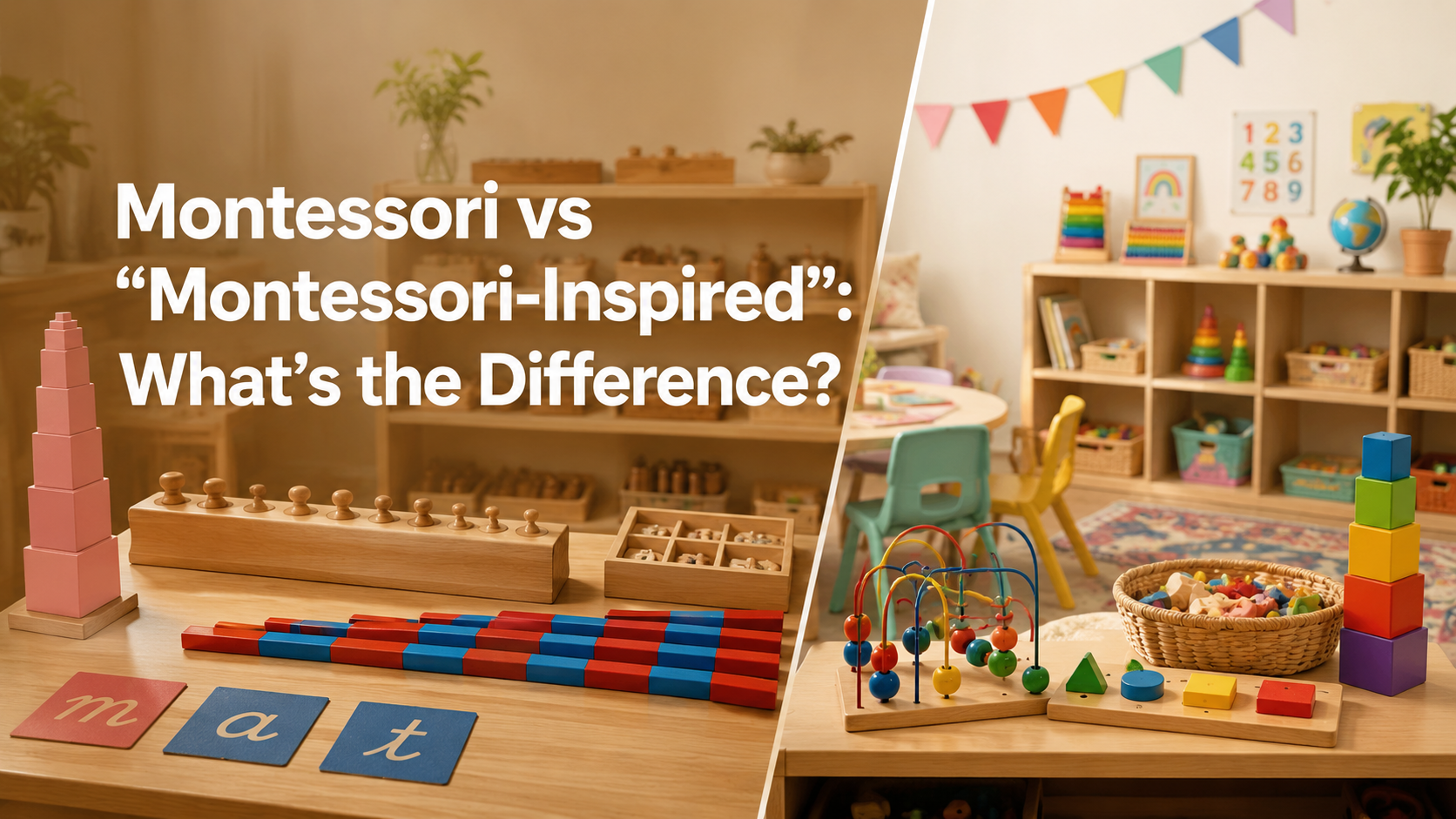
Walk into a modern playroom or browse early childhood accounts online, and you will encounter a distinct look. You will see unpainted wooden objects, low-profile, child-sized shelves, muted pastel rugs, and minimal clutter. The word Montessori is almost always stamped prominently on the product listing or the school brochure.
Many parents see this setup and instantly assume they are looking at authentic developmental education. But it is a mistake to reduce this profound philosophy down to a simple interior design trend.
Dr. Maria Montessori formulated a comprehensive educational system rooted in deep scientific observation, self-directed movement, intense concentration, and self-correcting materials. The aesthetic elements exist purely to serve a functional purpose.
This difference between the authentic method and inspired variations is important. Parents need to know what they are paying for when buying toys or picking a preschool.
For school owners, the distinction is even more high-stakes. Investing capital into classroom design without understanding the operational curriculum leads to poor learning outcomes and negative parent reviews.
This is where your choice of sourcing and implementation partner changes everything. Kidken Edu Solutions enters this space with over two decades of practical manufacturing experience. By producing certified, developmentally accurate classroom tools, the organization helps institutions and homes implement genuine Montessori principles instead of superficial design imitations.
What Does Authentic Montessori Really Mean?
Montessori is a method, not just a classroom style
Authentic Montessori education is a structured educational method based on how children learn naturally through physical interaction. Dr. Maria Montessori discovered that young minds have a strong ability to absorb learning from their surroundings from their direct surroundings when given freedom within a structured environment. The system relies on repetition and physical manipulation to build abstract cognitive paths in the brain. It is not an unstructured free-for-all, nor is it a traditional teacher-led lecture environment.
The child learns through purposeful work
In a genuine classroom, children do not just play with toys: they engage in purposeful work. Every object on the shelf has a specific developmental goal, a strict place in an educational sequence, and a built-in control of error. This design allows children to see their own mistakes without an adult constantly pointing out errors.
The adult is a guide, not a lecturer
The teacher in this environment does not stand at a blackboard delivering a uniform lecture to a passive group. Instead, the trained adult serves as a quiet guide or directress. Their job is to observe individual behavior, present precise lessons when a child shows readiness, and safeguard the child’s unbroken concentration. They connect the child to the correct material and then step back to let the learning happen.
What Does “Montessori-Inspired” Mean?
It borrows selected Montessori ideas
The term Montessori-inspired applies to environments, toys, or programs that adopt specific aspects of the philosophy without executing the complete system. A regular playroom with low shelves and an accessible wardrobe is Montessori-inspired. It values independence and child-led choice, which is excellent for general development, but it does not function as an complete Montessori learning environment.
It may not follow the complete Montessori method
An inspired space rarely includes the full suite of specialized apparatus or strict operational parameters. You will not find mixed-age grouping where three-year-olds and six-year-olds work together in the same room. Uninterrupted three-hour work cycles are typically absent, replaced instead by rigid timetables, scheduled circle times, or standard play-based activities.
It is not always wrong, but it should be clearly understood
There is nothing inherently wrong with an inspired space. Incorporating elements of independence and simple wooden tools into a standard home or a hybrid daycare is highly beneficial. However, consumers and educators must maintain complete clarity about what they are choosing so their performance expectations match reality.
Montessori vs Montessori Inspired: Key Differences at a Glance
| Factor | Authentic Montessori | Montessori-Inspired |
| Learning Method | Follows a strict, scientifically validated developmental sequence. | Incorporates generalized themes of independence and child-focused play. |
| Materials | Scientifically designed, single-purpose apparatus with built-in control of error. | Open-ended wooden toys, puzzles, or standard stacking games. |
| Teacher Role | Fully credentialed guide who relies on non-intrusive observation. | Standard facilitator, traditional classroom teacher, or parent. |
| Classroom Setup | Prepared environment arranged by strict curriculum areas and difficulty. | Child-friendly, low-clutter room that lacks a structured learning sequence. |
| Work Cycle | Uninterrupted three-hour blocks to cultivate deep cognitive focus. | Fixed, shorter activity periods controlled by an adult. |
| Age Grouping | Mixed-age groups spanning a three-year developmental window. | Single-age classrooms divided strictly by year of birth. |
| Curriculum | Structured across Practical Life, Sensorial, Language, Math, and Culture. | Blends selected traits with traditional thematic or play-based lesson plans. |
| Assessment | Rigorous qualitative observation logs tracking individual material mastery. | Standard worksheets, collective group goals, or generic milestone charts. |
The Prepared Environment: More Than Beautiful Shelves
Order, accessibility, and independence
The prepared environment is a physical manifestation of order. Every object sits on a low shelf in a progressive sequence moving from simple to complex, and left to right. This left-to-right arrangement is a subtle, intentional preparation for reading and writing. When a child knows exactly where an item lives, they can select it, use it on a floor mat, and return it without asking an adult for help.
Why child-sized furniture matters
Physical proportions dictate how a child perceives their ability to control the physical world. Tables, chairs, washstands, and sweeping brooms must match the child’s physical dimensions perfectly. This precise sizing builds raw motor control, coordination, and deep personal confidence. The child learns that they are an active owner of the room, not a guest in an adult world.
Where Montessori-inspired spaces often differ
An inspired space frequently prioritizes visual curation over functional utility. The shelves might look clean, but the items on them are often rotated at random without any regard for developmental prerequisites. When an environment loses its structural order, children become overstimulated, and the independent workflow quickly falls apart into standard chaotic play.
School owners can prevent this breakdown by utilizing structured support. Kidken Edu Solutions assists institutions through complete preschool setup consulting, supplying certified preschool furniture and organized curriculum packages that ensure every square foot of the classroom serves a distinct educational milestone.
Montessori Materials vs Montessori-Inspired Toys
Authentic Montessori materials isolate one concept
A genuine Montessori apparatus isolates exactly one physical variable at a time. Consider the iconic Pink Tower: every single block shares an identical texture, material, and color. The only changing attribute is the three-dimensional volume.
By isolating this single concept, the child’s brain can focus entirely on size discrimination without being distracted by conflicting colors or patterns. The Sandpaper Letters provide an identical tactile preparation for language, while the classic Number Rods use physical length to teach the foundational mathematical concept of quantity.
Self-correction builds confidence
The built-in control of error eliminates the need for adult approval or criticism. If a child stacks the Pink Tower incorrectly, the structure physically tips over, or a piece is left over at the end. The physical object provides immediate feedback, allowing the child to correct their own path independently, which builds true intellectual confidence.
Montessori-inspired toys may be useful, but different
Standard wooden blocks, complex shape sorters, and rainbow nesting arches are great for early childhood play. They encourage fine motor coordination and spatial awareness. However, they lack a rigid pedagogical progression and often mix multiple concepts together, making them general playthings rather than precise scientific learning tools.
What parents should check before buying
- Does the object isolate just one specific skill or concept?
- Is there a clear, physical way for the child to see their own mistake?
- Is the item built from durable, authentic materials like wood or metal?
- Can your child manage, carry, and clean up the object without help?
- Does the item encourage extended concentration, or does it rely on flashy batteries and sound buttons?
Teacher Training: The Missing Link Many Parents Don’t Notice
A trained adult knows when to step in and when to step back
The finest classroom materials are useless without a prepared adult. True Montessori teaching requires intense training in the art of non-intervention. A guide must watch a child struggle with an apparatus and resist the immediate urge to fix the problem, intervening only when the child is completely overwhelmed or mistreating the material.
Why presentation matters
Every material must be introduced to the child through a highly deliberate, silent physical demonstration. The guide moves their hands with slow, calculated precision to show how a tray is carried, how a cylinder is held, or how a letter is traced. This careful physical modeling gives the child a clear template for independent success.
Why preschool owners should invest in training
For school directors, buying a catalog of wooden products will never create a premium classroom. Success depends on preparing your staff to manage observation protocols, maintain long work cycles, and handle classroom dynamics without traditional rewards or punishments. True pedagogical depth is what retains clients and establishes market authority.
Montessori at Home vs Montessori in School
Parents do not need to recreate a full classroom
You do not need to convert your living room into a replica of a school classroom. Attempting to force a rigid school structure into a domestic home often creates unnecessary stress for everyone involved.
At home, the philosophy is best lived out through simple lifestyle habits. It means involving your toddler in real daily kitchen tasks, providing accessible hooks for coats, keeping a small number of open shelves, and stepping back while they practice putting on their own shoes.
Best Montessori areas for home use
- Practical Life Stations: Small step stools at the kitchen counter, child-sized spray bottles for cleaning, and accessible water dispensers.
- Sensorial Storage: Low shelves holding basic sorting items, geometric blocks, or tactile matching games.
- Language Corners: Low, forward-facing book displays and baskets containing realistic vocabulary cards.
- Fine Motor Trays: Simple scooping, pouring, or threading activities placed on small, manageable trays.
When to choose structured Montessori materials
Investing in accurate, high-fidelity learning tools becomes vital for homeschooling networks, early childhood centers, and families looking for structured alternatives to digital screens. These tools turn abstract concepts into physical objects that children can hold, making them exceptionally useful for early math and language preparation.
How School Owners Can Avoid a “Montessori-Looking” Classroom Without Montessori Depth
Start with curriculum, not décor
When launching a premium early childhood center, your design choices must follow your educational framework, never the other way around. A classroom should be mapped out around foundational developmental areas: Practical Life, Sensorial, Language, Mathematics, and Culture. If your floor plan is not built directly around this progression, your school remains a regular daycare with wooden shelves.
Invest in the right material sequence
A successful program requires a full material ecosystem. This means stocking a complete sequence of specialized tools, ranging from infant-toddler manipulation objects to advanced elementary math bead bars. Skipping important materials to reduce initial costs leaves your teachers without the tools they need to guide children through advanced concepts.
Plan the full ecosystem
To run a profitable and legitimate preschool, directors must manage a complex infrastructure:
- A calculated room layout that encourages free movement.
- Authentic Preschool Learning materials that comply with international specifications.
- Ergonomic, durable furniture built for daily classroom wear.
- Continuous professional development for teaching staff.
- Transparent observation tracking systems to show real progress to parents.
Partnering with an end-to-end provider prevents common setup mistakes. Kidken Edu Solutions provides a comprehensive nursery setup service that combines precision manufacturing with strategic guidance, ensuring your school opens with genuine educational depth rather than just an attractive aesthetic.
Signs a School Is Truly Montessori
Ask these questions during a school visit
- Are the head teachers certified by recognized training bodies like AMI or AMS?
- Do children select their own work independently, or is the entire class moving in unison?
- Is there an unbroken, multi-hour work period every morning?
- Are the children grouped in mixed-age classrooms spanning a three-year range?
- Are students encouraged to repeat an activity as many times as they want?
- Does the classroom feel calm, orderly, and productive without relying on teacher shouting?
Red flags to watch for
- The word Montessori is used prominently in marketing, but traditional plastic toys fill the shelves.
- The daily routine relies heavily on uniform, teacher-led worksheets for three-year-olds.
- Children are divided strictly into separate, single-year age brackets.
- Teachers spend the day standing at the front of the room lecturing the whole group.
- The school lacks distinct, organized areas for Practical Life and Sensorial development.
Is Montessori-Inspired Learning Still Useful?
Yes, when expectations are clear
Using an inspired model remains highly beneficial for daycares, home play spaces, and casual learning environments. Embracing the core values of respect, self-reliance, and clean space setup improves early motor skills and focus. The key is simply understanding the operational boundaries of this casual approach.
Best use cases for Montessori-inspired learning
- Designing safe, low-clutter home bedrooms and play areas.
- Selecting thoughtful birthday gifts that promote open-ended play.
- Structuring daily family routines that encourage self-care and chores.
- Setting up casual activity corners in traditional daycares or neighborhood playgroups.
When authentic Montessori matters more
If you are establishing a professional kindergarten, managing an official preschool franchise, or running a structured home-education curriculum, adhering strictly to the authentic method is critical. This precision ensures your students reap the full cognitive benefits of the system, setting them up for long-term academic success.
Where Kidken Edu Solutions Fits In
Built for parents, schools, and institutions
Operating an authentic early childhood space requires access to precision-manufactured tools that meet international standards. Kidken Edu Solutions bridges the gap between educational theory and real-world execution by providing a comprehensive product and service ecosystem.
Trust signals and manufacturing standards
Kidken Edu Solutions is a Bengaluru-based manufacturer backed by over twenty years of industrial experience. The company holds ISO 9001:2015 and ISO 14001:2015 certifications, and its materials are fully BIS-certified. Having served over 7,500 schools across 15 countries, Kidken ensures your investment is backed by global durability and exact educational safety standards.
Strategic partnership options
- For School Owners: End-to-end consulting, premium furniture manufacturing, verified material sequences, and custom curriculum planning to scale strong early learning centres.
- For Parents: Access to highly durable, screen-free development tools and open shelf storage systems to build independent homes.
Frequently Asked Questions
1. What is the main difference between Montessori and Montessori-inspired?
2. Is Montessori-inspired bad for children?
3. How can I tell if a school is truly Montessori?
4. Are wooden toys the same as Montessori materials?
5. Can parents use Montessori at home?
6. What age is best to start Montessori learning?
7. What should preschool owners buy first for a Montessori classroom?
8. Does Kidken provide Montessori materials for schools and homes?
Choose Montessori With Clarity, Not Just Aesthetics
True Montessori education is never a mere cosmetic look: it is a lifelong commitment to child-led development. While inspired home play spaces are great for early independence, running a successful school requires authentic materials, proper teacher training, and a rigorous structural sequence.
Whether you are designing a screen-free home corner or building a complete commercial preschool from the ground up, look beyond superficial design trends. Explore certified collections, premium furniture lines, and full classroom setup packages at kidkenmontessori.com.