
Blog
Montessori vs Traditional Preschool: Which Is Better for Growth & Admissions?

Introduction
Are you designing an early childhood program that genuinely prepares students for the future, or are you just replicating old models? For school founders, trustees, and educational leaders, structuring a preschool program involves balancing deep pedagogical theory with practical school operations. The long-running choice between a Montessori vs Traditional Preschool framework is rarely about style. Instead, it is a deliberate decision that dictates how a child processes information, handles problem-solving, and builds long-term learning habits.
This operational decision directly forms the foundation of your institutional reputation, enrollment retention, and market authority. Modern, discerning parents no longer accept basic daycare services. They actively demand early childhood programs that yield visible developmental milestones while ensuring a competitive edge during primary school admissions. To build a highly profitable and respected educational brand, you must look past simple marketing brochures to dissect the structural mechanics of both learning frameworks.
For parents, this choice affects how their child builds independence, confidence, language, social behaviour, and school readiness. For school owners, it affects admissions positioning, classroom operations, teacher training, and long-term parent trust.
Montessori vs Traditional Preschool — Quick Answer
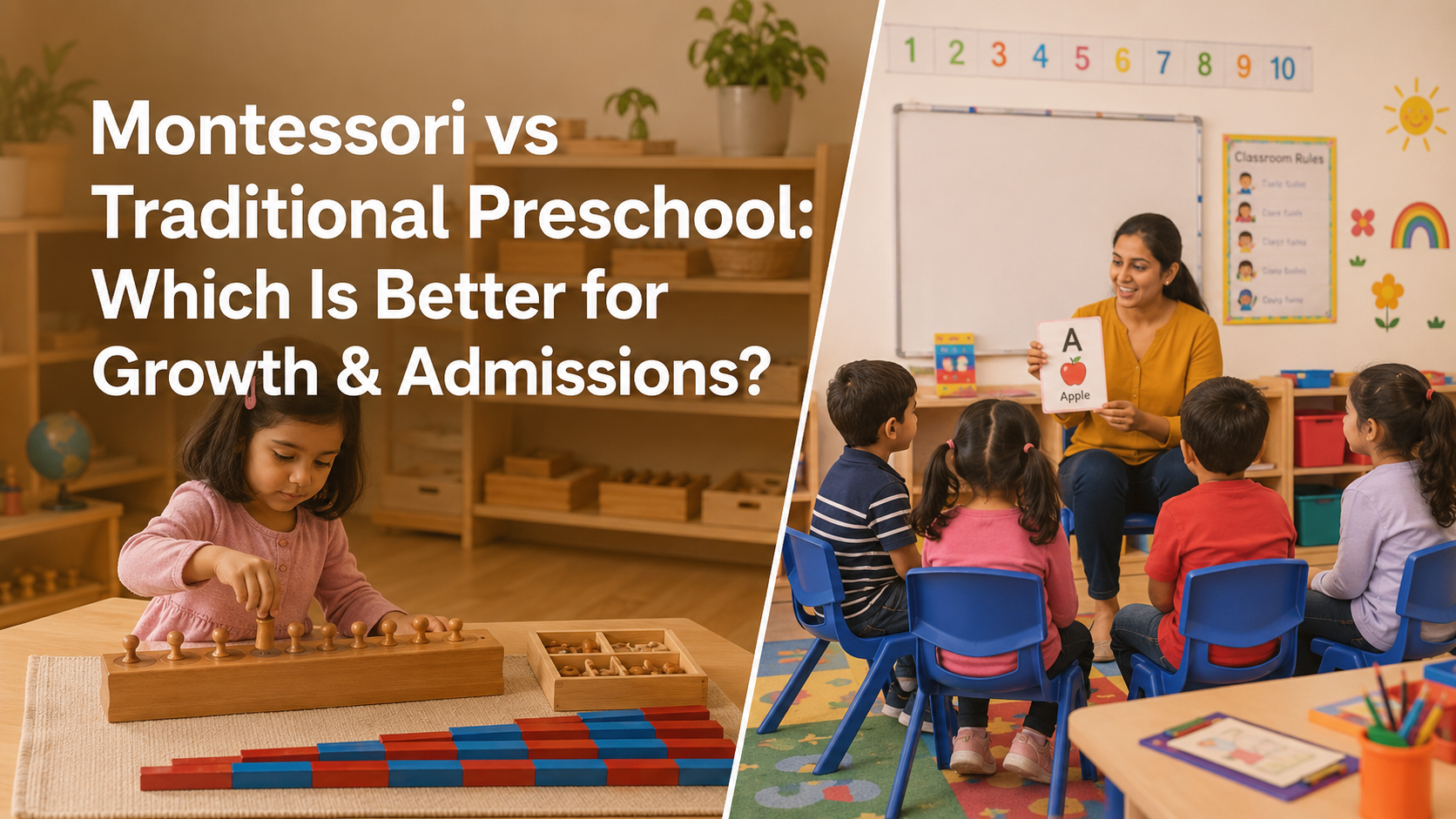
A Montessori Preschool balances learner independence, self-directed work cycles, and long periods of deep focus inside an intentionally arranged environment. Conversely, a Traditional Preschool uses direct teacher instruction, strict time-blocked routines, and uniform academic goals to guide an entire class simultaneously.
In simple terms, Montessori gives children more freedom within a prepared structure, while traditional preschool gives children more direct instruction within a fixed routine.”
So, while a Traditional Preschool Education standardizes performance to match formal school systems, a Montessori Preschool Education encourages self-paced conceptual mastery using sensory tools. Both frameworks can produce exceptional results, but final student outcomes depend heavily on structural investment and daily execution.
What Is Montessori Preschool?
Methodology
The Montessori model turns the traditional classroom hierarchy upside down by turning the teacher into a trained guide and observer rather than a lecturer. Children work in a carefully prepared environment where every shelf and object serves a distinct cognitive purpose. Classrooms feature mixed-age groups, usually combining children from two and a half to six years old. This layout mimics a real community, allowing natural peer-to-peer mentoring to happen without artificial age division.
Focus Areas
This method focuses on building internal motivation, practical life proficiency, and natural self-regulation. Children select their individual tasks from open shelves, taking full ownership of their work cycle, physical workspace, and time tracking. This active independence removes the need for arbitrary gold stars or uniform punishments, protecting a child’s natural curiosity.
Growth Impact
By prioritizing hands-on experience over passive memorization, early learners build a permanent, deep understanding of complex subjects. For instance, instead of writing numbers on a blank chalkboard, a student handles weighted decimal bead materials to physically feel the difference between units, tens, and hundreds. This concrete practice ensures that abstract math processes become second nature later on.
Social Development
The mixed-age structure changes how social bonds form. Older students naturally learn early leadership, empathy, and verbal expression by presenting activities to their younger peers. Meanwhile, younger children watch this advanced work, which keeps them engaged and gives them a behavioral blueprint without direct teacher policing.
What Is Traditional Preschool?
Methodology
Traditional Preschool Education is built on teacher-led instruction. The educator leads the entire room from the front, running a standardized curriculum through synchronized group intervals. The school day follows a rigid, timed calendar that alternates between group circle time, alphabet worksheets, structured arts and crafts, and scheduled playground breaks.
Focus Areas
The main goals center on meeting clear academic milestones like early literacy, phonics drill recognition, and linear numeracy. The entire class moves through identical lesson plans at the exact same speed, focusing heavily on rote repetition, pencil-and-paper worksheets, and group participation and classroom routine.
Growth Impact
This structured approach helps children adapt smoothly to the mechanics of conventional primary schools. By training children to follow direct orders from an authority figure, sit quietly at desks for fixed periods, and move systematically between distinct subjects, it builds functional classroom discipline and predictable study habits.
Social Development
Social connection in a traditional setting happens exclusively within a single age bracket. Children participate in highly structured team-based activities, large-group games, and uniform holiday performance practice. This environment sharpens their capacity to share, take turns, and find their place within their immediate demographic peer group.
Montessori vs Traditional Preschool (Side-by-Side Comparison)
| Operational Area | Montessori Preschool | Traditional Preschool |
| Learning Style | Self-paced, child-led exploration. | Standardized, teacher-directed lessons. |
| Teacher Role | Scientific observer and individual guide. | Central instructional leader and manager. |
| Classroom Structure | Mixed-age cohorts (2.5 to 6 years). | Same-age cohorts (divided by birth year). |
| Curriculum Flow | Individualized mastery using physical objects. | Group-wide progression via strict timetables. |
| Growth Outcome | Deep conceptual understanding, self-reliance. | Predictable academic milestones, routine adaptation. |
| Socialization Style | Peer-to-peer mentoring across ages. | Large-group cooperation among immediate peers. |
Which Is Better for Child Growth?
Answering which system is genuinely better requires looking at what kind of developmental traits you want to cultivate. The Montessori framework excels at developing sustained cognitive concentration, refined motor skills, and spatial awareness. Because children work with an apparatus uninterrupted for hours, they develop a long attention span that traditional short subject blocks usually disrupt.
But traditional preschools excel at producing classroom readiness and group routine and clear group socialization. For a child who requires short-term external boundaries and predictable group energy to feel secure, the traditional framework provides a very clear sense of direction. Hence, optimal growth is never a consequence of a school’s ideological label. It is a direct result of how faithfully the school executes its core methodology every day.
Which Is Better for Admissions?
The Montessori Advantage
Graduates from authentic Montessori spaces are highly sought after by top K-12 school admission panels because they are disciplined self-starters. They display advanced analytical thinking, rich vocabulary, and comfortable emotional resilience. During admissions testing, these children consistently show strong problem-solving skills, independence when facing new tasks, and high situational confidence.
The Traditional Advantage
Children from traditional programs have an advantage when applying to elite primary schools that use conventional, strict entry tests. Because their preschool background includes desk work, timed testing mechanics, and direct instruction, they know how to handle an assessment room. They decode and answer standardized prompts quickly, matching the exact operational expectations of traditional school interviewers.
The Real Problem Most Schools Face
Many preschool owners launch a Montessori program only to face operational failure. But the problem does not lie within the philosophy itself. It stems from severe execution gaps. A common error is treating the method like a trendy marketing sticker, buying a few wooden geometric blocks while keeping a rigid, timed class schedule.
Without a fully prepared environment, an uninterrupted Montessori work cycle, and an expert teacher who knows when to step back, the room quickly turns chaotic. And if you fail to educate your parent community on why their children are not bringing home stacks of traced worksheets every single afternoon, trust breaks down. This communication gap fuels parent anxiety, hurts enrollment retention, and drives negative word-of-mouth.
What Makes Montessori Actually Work
True operational success requires a total commitment to structural authenticity. You must design a physical space centered on absolute order, clear lines of sight, and accessible independence. Schools must invest in high-fidelity Montessori educational materials that cover practical life skills, sensorial refinement, mathematics, and language development.
Every single item must be physically complete, perfectly maintained, and placed on low, open shelving. Most importantly, your institution must hire or train guides who are experts in scientific observation. This ensures that these specialized developmental tools are introduced systematically to match each child’s individual readiness.
How Parents Perceive Both Models
Preschool enrollment is heavily steered by local parent perceptions. Modern families want clear proof of cognitive development, speaking confidence, and transparent communication from school leadership. Traditional models meet these tracking expectations easily by distributing graded workbooks, uniform art projects, and numerical report cards.
To achieve this level of institutional trust, a Montessori campus must actively pull back the curtain on its daily operations. You must teach parents to recognize that a child spending an entire morning washing a wooden table is not simply playing. They are actively refining hand-eye coordination, building focus endurance, and strengthening their finger muscles for future writing. Aligning your internal metrics with parent understanding is what preserves long-term premium enrollment.
Montessori vs Traditional — Which Should You Choose?
Choose Montessori If
- You want to run a premium, highly differentiated educational institution that focuses on long-term logical intelligence and student self-reliance.
- Your management team is fully prepared to invest heavily in certified training, authentic Montessori materials and child-sized furniture, and open architectural layouts.
Choose Traditional If
- Your primary goal is to prepare children for conventional, assessment-driven local K-12 school networks that expect immediate academic compliance.
- You prefer a highly predictable, standardized operating system with easy-to-replace curriculum sheets and uniform group classroom schedules.
Common Mistakes to Avoid
The most expensive mistake an education brand can make is using Montessori as a casual design theme. Mixing cheap imitation plastic blocks into a teacher-led, worksheet-based classroom ruins the advantages of both systems.
Cutting corners on teacher training to preserve short-term capital leads directly to classroom management collapse. Finally, forcing instant, uniform academic outcomes onto a child-led space breaks the natural mastery cycle. True growth requires administrative patience, precise resource allocation, and a deep trust in your chosen pedagogical model.
How to Implement Montessori the Right Way
To build an authoritative early learning center that outperforms local competitors, execute these strategic setup steps:
- Plan the Environment: Secure large, sunlit rooms that allow children to move freely between learning zones without crowding.
- Select Authentic Materials: Purchase complete, structurally accurate Montessori material sets from proven educational manufacturers like Kidken Edu Solutions to ensure precise scale and long-term durability.
- Train the Educators: Invest in deep capacity-building programs, presentation workshops, and formal certification paths for your entire teaching staff.
- Follow a Daily System: Protect the mandatory, uninterrupted three-hour morning work window from arbitrary school schedule changes.
- Educate the Parents: Run regular orientation sessions and live classroom observations so families understand the deep cognitive intent behind all preschool educational activities.
Frequently Asked Questions
1. Is Montessori better than traditional preschool?
2. Which is better for long-term growth?
3. Which helps more in admissions?
4. Is Montessori expensive to set up?
Conclusion
Your decision between a Montessori and a traditional preschool blueprint shapes the operational, financial, and educational future of your institution. A traditional setup offers linear, predictable group management, while a Montessori framework cultivates profound mental independence and self-directed mastery. Ultimately, the chosen pedagogy rarely fails on its own. Poor implementation does. Long-term institutional authority belongs to the school leaders who select a clear educational vision, source authentic materials, and maintain absolute execution standards on the ground.
CTA
If you are preparing to launch a premium preschool or upgrade your current campus infrastructure to clear international early learning standards, partner with an established industry expert. Contact a school setup consultant at Kidken Edu Solutions today to explore a premium range of authentic Montessori materials, custom child-sized furniture, and intensive teacher orientation programs designed to build a world-class foundation for your educational brand.