
How to Choose the Right LKG Notebooks for Early Writing and Number Practice

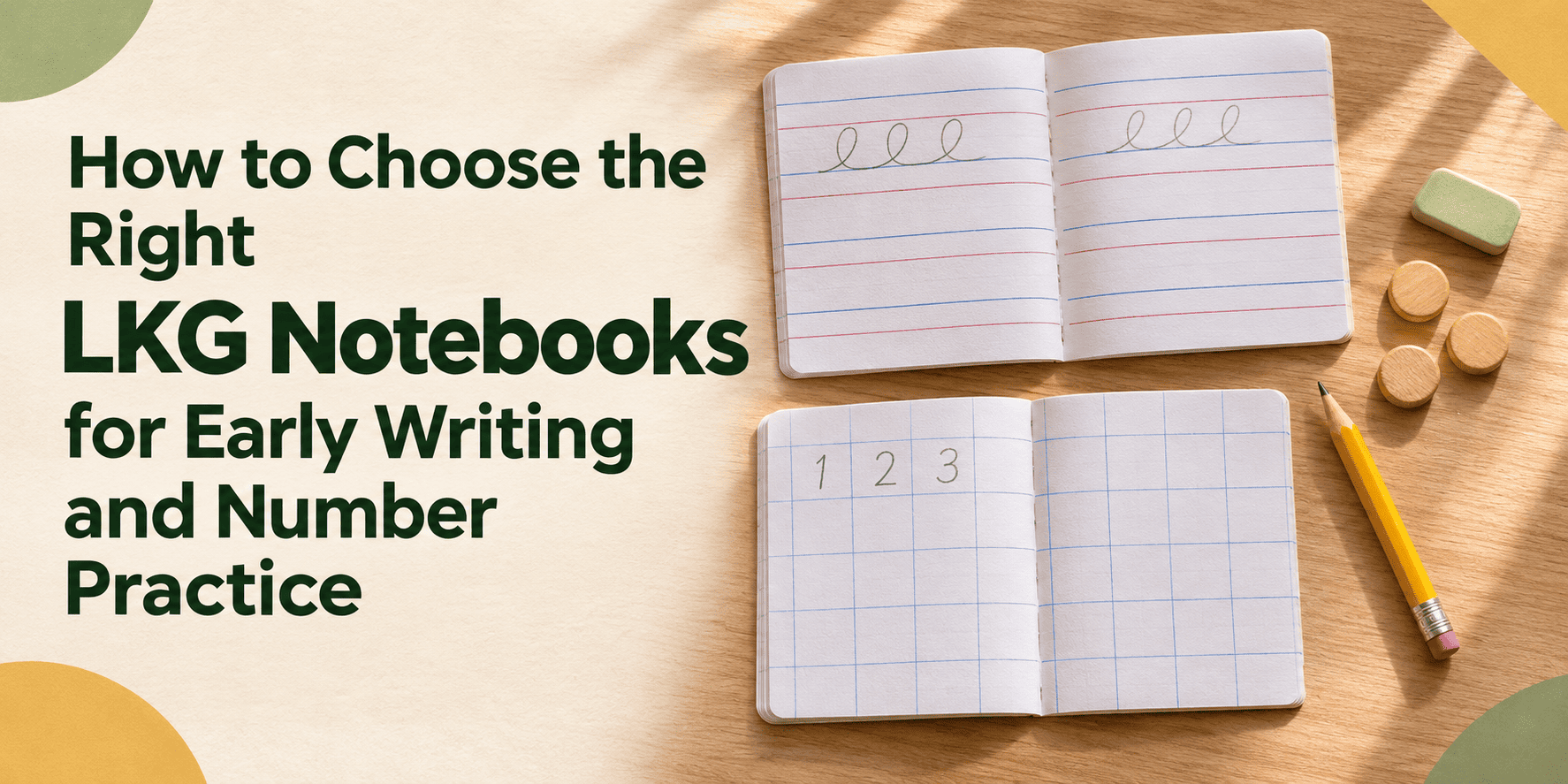
Choose LKG notebooks with clear lines and enough room for the letters and numbers your child can form comfortably today. Start with the school’s list, then look at a sample page. Does the letter style match the one the teacher uses? Can your child hold the page open and see where to begin? Leave room in the day for drawing, counting real objects and reading together, too.
Which Notebook Types Does an LKG Child Need?
A notebook gives your child space to work: blank pages for drawing, lines for letters or squares for numbers. A printed workbook supplies the task, perhaps a letter to trace or a group of objects to count. When browsing books for kindergartens, check which of these the teacher has requested. You may not need both for every subject.
English Writing Practice
Look at a letter your child has written at school and compare its size with the space on the sample page. If their letters only fit when squeezed between the lines, look for wider spacing. Our LKG English writing practice book uses print. If the class is learning cursive, ask the teacher for a sample first and choose a book whose letter shapes match it.
Number Practice
Put three blocks on the table. Invite your child to move each block as they count, then show them how to write the numeral 3 beside the group. Look for a page that leaves room for both curves of the 3. A whole row of tiny boxes offers little space to try that movement.
Drawing and Pre-Writing Practice
A blank page is useful when your child enjoys drawing but finds a narrow tracing path difficult. Draw a road for a toy car and invite them to continue it. The road might run straight or bend around a house; either gives the pencil movement a purpose.
What Should You Check Before Buying?
Open LKG notebooks near the middle as well as at the front. The cover tells you the level; an inside page shows what your child will actually be asked to do.
- Ruling and layout: Look for clear guides and enough white space to distinguish the example from the place where your child writes.
- Paper and binding: If a sample is available, try an ordinary pencil and gently erase a mark. Check that the sheets stay secure and the book opens without a struggle.
- Size: Your child should be able to steady the page with one hand while writing with the other.
- Activity sequence: In a guided workbook, look for a chance to try the letter independently after tracing it. A blank notebook leaves you free to draw a larger example or offer more room for another attempt.
If you’re ordering online, look for inside-page previews in the product photos.
How Can Parents Make Writing Practice Easier?
At Kidken, we suggest starting with one mark rather than a whole row. If the class is working on the letter c, write it slowly where your child can see your hand. Leave a generous gap beside yours for their attempt. If the curve is difficult on paper, roll a piece of clay into a long strip and shape it into a c together.
Let the child’s response guide what happens next. They might want another go, or they might turn the curve into a drawing. If their hand feels tired or they grow frustrated, put the book aside. There’s no need to finish the page that day.
How Do Reading Books Complement Writing Practice?
With books for kindergarten reading, the pencil can stay on the shelf. Read a page aloud and give your child time to tell you what is happening in the picture. Familiar kindergarten story books also offer a chance to recognise a letter from class, perhaps spotting the first letter of their own name in the title. Browse our books for kindergartens for reading alongside handwriting practice.
A Quick Checklist Before You Order
Keep the teacher’s list beside you as you check your basket:
- Match the writing style and ruling to the classroom example.
- Review a sample activity your child could try now.
- Check what you already own. If you already have storybooks and an English writing book, a number workbook may be all that’s missing.
Choose the Page Your Child Needs Next
Picture your child opening the book tomorrow. If they can find the starting point and have room to make their own attempt, the page is a practical fit. Compare LKG notebooks by layout and activity level, then explore the learning books from Kidken Edu Solutions.
Frequently Asked Questions
Which notebook ruling should I choose for an LKG child?
Follow the school’s recommendation. If the list just says ‘ruled’, ask to see a classroom page so you can match the number of guide lines and the space between them.
Should I choose print or cursive writing practice?
Use the style being taught in class. A sample of the teacher’s lowercase letters is more useful than guessing from the age label on a cover.
What is the difference between a notebook and a workbook?
In a notebook, the teacher, parent or child decides what goes on the page. A workbook already contains activities to complete, such as tracing a shape or counting pictured objects.
How can I tell whether a writing activity is too difficult?
Watch what happens after you demonstrate it. If your child cannot find where to start or repeatedly runs out of room, try the same movement on a larger blank page.
How do I know if my child is ready to start writing in a notebook?
Interest in copying a mark or adding a letter to a picture is a good reason to offer a page. Ask the teacher which familiar classroom activity to try first.
Are tracing workbooks useful before independent letter writing?
Tracing gives a child a path to follow. Leave space beside the example for a freehand attempt when they want one; it need not look exactly like the model.
Should I choose a square-ruled notebook for number practice?
Choose squares if the teacher asks for them, and check their size against your child’s numerals. For home practice, an unruled page also leaves space to draw a group and write its number alongside.
How much writing practice should an LKG child do at home?
One attentive attempt may be enough. Continue while your child is interested and comfortable, without setting a daily page target.
What can I do if my child avoids notebook activities?
Put the notebook away for a while. Try drawing with chalk or sharing books for kindergarten reading. Later, offer a small reason to write, such as adding an initial to a drawing.
Should I buy a complete LKG book set or individual practice books?
Buy the set if its contents match the school’s list. If the school supplies most materials, individual titles let you fill the gaps without duplicating books.